
Electric Bicycle Safety & Law
Governor Approves SB 1167, Clarifying E‑Bike Standards - Governor Gavin Newsom signed SB 1167 on September 30, 2026, establishing clearer distinctions between e‑bikes and higher‑powered e‑motos to strengthen safety and consumer transparency. The law takes effect January 1, 2027, helping Californians make informed choices as electric mobility continues to grow. Find more information below.
Because electric bicycles (e‑bikes) operate differently from traditional bicycles, California law includes several important rules designed to foster a safer environment. Riders, especially youth and their parents or guardians, are encouraged to review the guidelines on this page to understand age requirements, helmet rules, equipment standards, and where different devices are allowed to operate.
What is An E-bike?
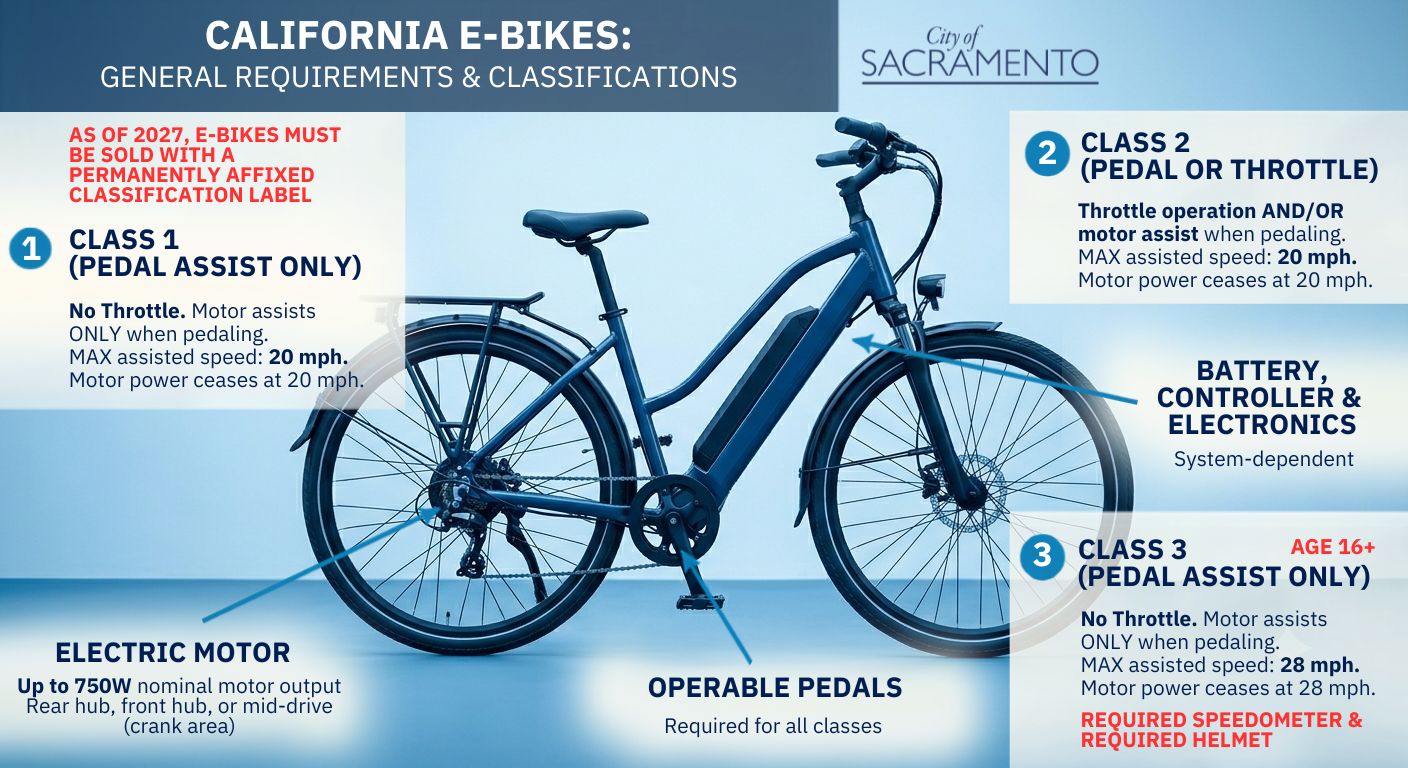
California Vehicle Code (CVC) § 312.5 defines an electric bicycle (e-bike) as a bicycle with fully operable pedals and an electric motor of no more than 750 watts continuous power.
In Sacramento, e-bikes may operate wherever traditional bicycles can operate. That includes all of the City’s bike lanes, bikeways, and shared-use paths.
California classifies e‑bikes into three categories:
- Class 1: Pedal‑assist only; motor assists while pedaling and stops at 20 mph; no throttle.
- Class 2: Includes throttle or pedal‑assist; motor may be used without pedaling but still limited to 20 mph.
- Class 3: Pedal‑assist only; stops assisting at 28 mph; must have a speedometer; riders must be 16 or older and must wear a helmet.
As of January 2027, all e-bikes sold must have a classification label stating the e-bike class, top assisted speed, and maximum motor wattage.
It is illegal to modify an e-bike such that it no longer meets the legal definition of an e-bike.
Is Your E-bike Compliant with California Law?
.png/_jcr_content/renditions/cq5dam.web.1500.1500.jpeg)
Find out whether your e-bike meets California requirements. Expand to view full graphic.
Other E-Vehicles
E‑bikes within the classes described above are legally treated as bicycles. No license, registration, or insurance is required. However, any vehicle exceeding these limits (more than 750 W, faster than 28 mph, or without operable pedals) is classified as a motor vehicle and must comply with applicable laws.
- E‑mopeds require riders to be at least 16 years old, hold the appropriate driver’s license with a motorcycle endorsement, display registration and license plates, and wear DOT‑approved helmets. These vehicles cannot be operated on bikelanes, bikeways, or shared use trails.
- E‑motos, which are off‑highway electric motorcycles, must be registered with the DMV as OHVs, used only in designated off‑highway areas, and operated with DOT‑compliant helmets.
- Motorized scooters, including shared rideables, are also subject to restrictions. Operators must be at least 16 years old and hold a driver’s license or valid learner’s permit. Motorized scooters cannot carry passengers. They can be operated in bike lanes and bikeways, but unlike bicycles and e-bikes, they cannot be operated on sidewalks.
These distinctions matter because different vehicle types come with different safety expectations and legal requirements. Families should ensure that youth are riding only devices that match their age, skills, and the law.
Governor Approves SB 1167, Clarifying E‑Bike Standards
California’s new law, SB 1167, signed on September 30, 2026, helps ensure buyers can easily distinguish between legal e-bikes and higher‑powered electric mopeds or “motor-driven cycles” (e-motos). E-bikes must have working pedals, motors under 750 watts, and top assisted speeds of 20 mph (throttle) or 28 mph (pedal assist).
Beginning January 1, 2027:
- Accurate Labeling: Faster, more powerful devices are now classified as motor-driven cycles or mopeds and must follow motor‑vehicle rules, including proper labeling, age restrictions, and—where applicable—registration, licensing, insurance, and helmet requirements.
- Stronger Consumer Protections: Mislabeling high‑powered devices as e-bikes is now illegal, and sellers must disclose when a product falls under motor‑vehicle regulations.
- New Enforcement: Law enforcement may remove unregistered high‑speed devices from bike paths and pedestrian areas.
- Data collection: Requires law enforcement officers to include all information from a device’s label, such as brand, manufacturer, top speed, wattage, and classification, in any crash or injury report, and to note when a label is missing.
Why It Matters: These updates help ensure riders purchase the right device for their needs, support safer streets, and improve the biking experience for everyone.
Helmets
All riders under 18 years old, including passengers on any bicycle or e‑bike, must wear a properly fitted and fastened helmet that meets CPSC or ASTM safety standards.
This requirement applies whether youth are riding on their own or seated in a child seat or trailer.
On Class 3 e‑bikes, which can reach higher assisted speeds, helmets are required for all riders and passengers, regardless of age.

Youth E-Bike Safety and Parent / Guardian Liability
E-bikes offer a fun and active way for families to explore the city, but understanding California’s safety rules and parental liability is essential.
Under California Civil Code Section 1714.1, parents or guardians can be held jointly liable for up to $25,000 per incident for a minor's willful misconduct that results in injury, death, or property damage. Parents are encouraged to provide close supervision, review their insurance coverage, and choose age-appropriate equipment that aligns with State age, helmet, and licensing requirements.
Ultimately, establishing clear boundaries, practicing open communication, and reinforcing responsible riding behaviors, like obeying traffic laws and respecting pedestrians and fellow cyclists, helps ensure safer and more predictable trips for young riders and the entire community.

Resources for People Biking and Scooting

Free monthly class on city biking and scooting laws and safety.
A map of all the existing bikeways in the City (Updated summer 2025)
An interactive look at the City’s existing and planned bike facilities.

Tool for reporting hazards on bikeways and shared-use paths.