
Equitable and Resilient Urban Forest Project
The Sacramento Equitable and Resilient Urban Forest project is a collaborative, community-based campaign to accelerate equitable expansion of urban tree canopy and tree benefits in low-canopy under-resourced neighborhoods within the city.
Funding for this project is provided by $1 million in competitively-awarded grant funding through the Inflation Reduction Act and the USDA Forest Service, Urban and Community Forestry Program in partnership with GreenLatinos. The grant-funded project term extends until November 2027; however, ongoing implementation of these grant-funded efforts is contingent on the continued availability of awarded federal funds.
The project consists of three major elements:
Urban forest expansion and community engagement
The citywide average urban tree canopy is 19%; however, tree canopy coverage varies substantially between residential areas, ranging from 10% to 40%. The project seeks to support equity in access to trees and green space by increasing tree planting efforts in low-canopy, under-resourced neighborhoods. The project scope includes planting 450 trees and installing appropriate irrigation systems to support water-wise establishment and care at parks, along streets, and on other public facilities.The Climate Action and Sustainability Team worked with the Department of Youth, Parks and Community Enrichment (YPCE) to host 14 events to plant 489 trees, which exceeded the grant goals!
- Sacramento Northern Parkway: In November 2024, the grant kick-off event together community groups and residents from across the city to plant trees along one mile of the Northern Parkway trail, extending from North Avenue to Arcade Creek. Together over 460 volunteers attended the event to plant 215 trees!
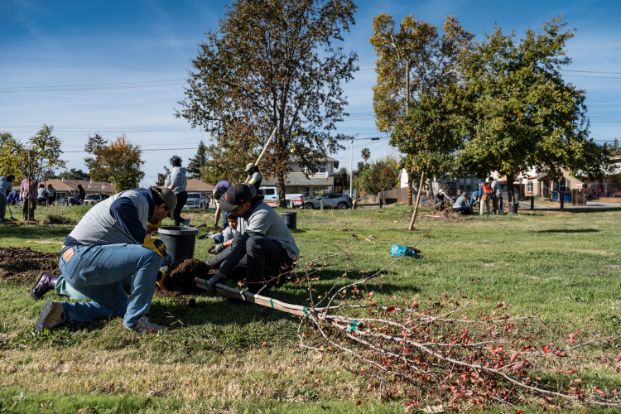
Photo credit: Lisa Stone Photography
- Colonial Park: In November 2025, over 50 volunteers planted 17 trees.
- Earl Warren Park: In November 2025, over 15 volunteers planted 5 trees.
- Woodbine Park: In November 2025, 11 volunteers planted 15 trees.
- Southside Park: In November 2025, 27 volunteers planted 15 trees.
- Robert Brookins Park: In December 2025, 23 volunteers planted 15 trees.
- Margarette “Mama” Marks Park: In December 2025, 21 volunteers planted 15 trees.
- Thomas Jefferson Park: In January 2026, 60 volunteers planted 15 trees.
- Robla Community Park: In January 2026, over 15 volunteers planted 22 trees.
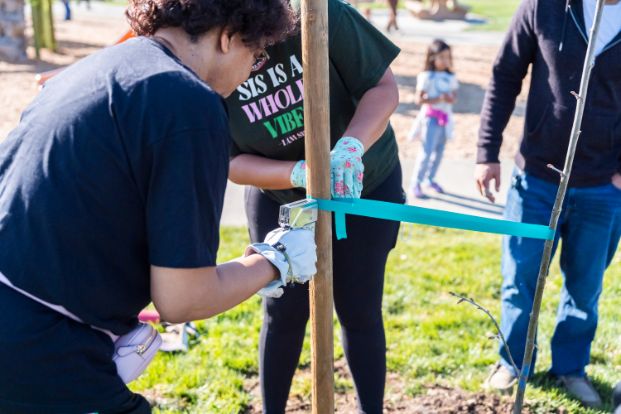
Photo Credit: Youth Parks and Community Enrichment Department
- Leslie Wood Park: In February 2026, over 25 volunteers planted 16 trees.
- Gardenland Park: In February 2026, over 90 volunteers planted 15 trees.
- Triangle Park: In February 2026, over 70 volunteers planted 17 trees.
- Edward Kemble Park: In March 2026, 84 volunteers planted 24 trees.
- Meadowview Trail: The final event for the grant program in April 2025 brought together community groups and residents from across the city to plant trees along the Meadowview Trail (between Richfield and Tungsten Way). Together over 130 volunteers attended the event to plant 45 trees!
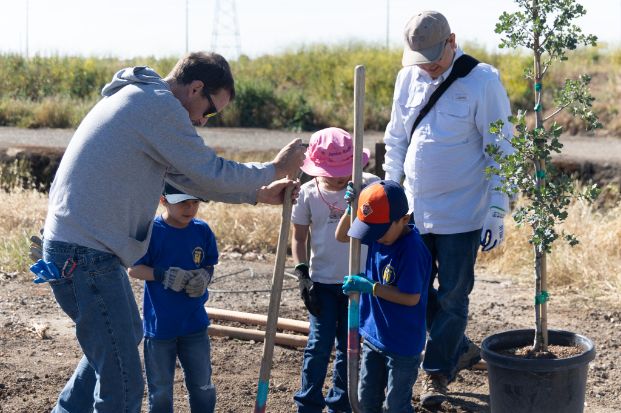
Photo Credit: CAL Fire
Urban forest maintenance
This project provides systemic maintenance and storm recovery support to improve resilience of the natural riparian forest at the Sacramento Marina and Miller Regional Park, a 90-acre site that provides a rare natural recreational area in a location of the city with few other nature access opportunities.
The City has performed systemic maintenance activities including:
- Pruning trees to correct structural defects and reduce end weight over buildings and walkways.
- Removing trees for the following reasons:
1) uncorrectable structural defects that could result in failure over docks and walkways posing a high risk to public safety,
2) invasive non-native species that pose a risk to the health of the native riparian woodland,
3) dead trees, and
4) beaver damage to trees near structures or roads that pose a risk to property and public safety.
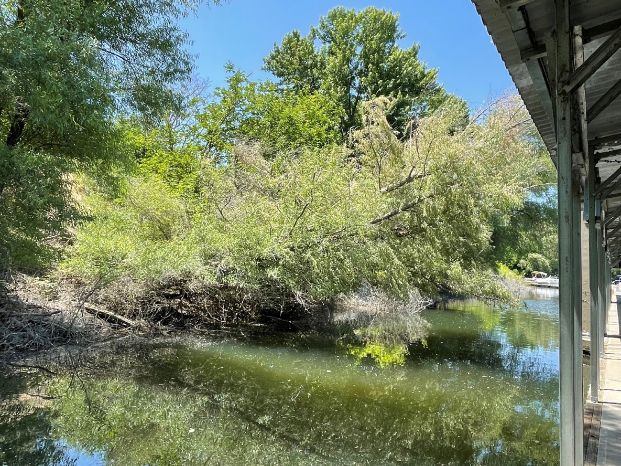
Before maintenance work was completed at the Sacramento Marina
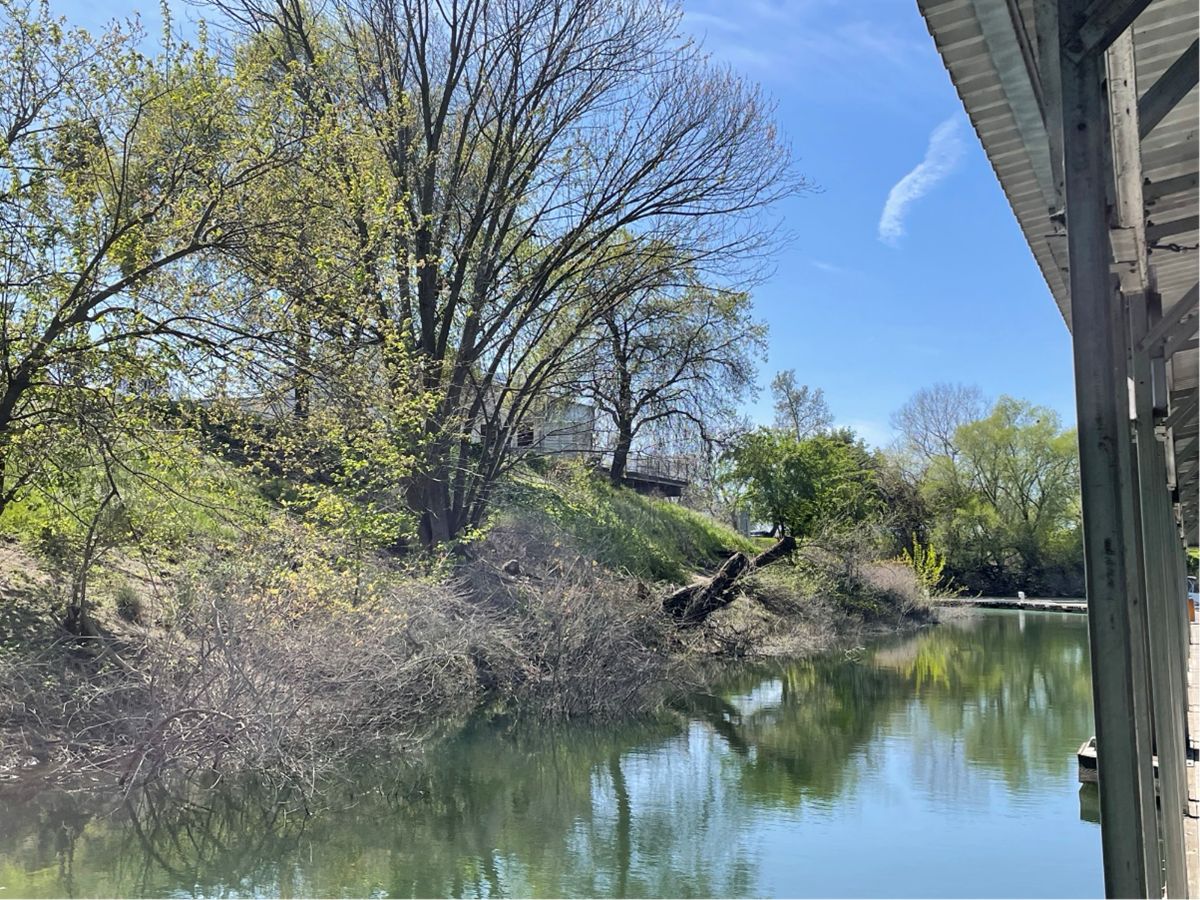
After maintenance work was completed at the Sacramento Marina
Parking lot greening
In 1983, the City implemented a parking lot shade ordinance requiring 50% tree shade cover on parking lots within 15 years of installation. However, parking lots developed prior to the ordinance were not required to have trees and many developed since have struggled to meet the requirement.
The Sacramento Urban Forest Plan found that the average parking lot canopy in the city is 15.3% and only 5% of parking lots meet or exceed 50% shading. UC Davis researchers estimated that planting trees in parking lots throughout Sacramento to reach 50% shading on paved areas would reduce hydrocarbon emissions by ~1 ton per day through reduced air and pavement surface temperatures.
This project aims to reduce urban heat islands and improve air quality through piloting a parking lot de-paving and greening project. The project will develop a “Parking Lot Greening Guidebook,” incorporating lessons learned from the pilot, to help property owners identify low-cost, high-impact greening projects for voluntary compliance with the parking lot shade ordinance. The pilot project will be pursued in 2026-2027.
Get involved
Subscribe to the Urban Forest Plan newsletter
Your insight helps the City learn what makes parking lot greening a success!