
5. Infill Development
Infill development plays a critical role in meeting our housing and climate goals by efficiently using available land and infrastructure, while also fostering more inclusive and accessible neighborhoods for a range of income levels. On this page, you can learn more about infill housing development.
Infill housing development
“Infill development” refers to building within unused and underutilized lands within existing development patterns, typically but not exclusively in urban areas. Examples of infill housing could include:
- a new home on a vacant lot in an established residential neighborhood
- a new accessory dwelling unit in the backyard of an existing single unit home
- a new mixed-use development in place of an existing underutilized land use in an existing commercial corridor
Development that is not considered infill is typically referred to as “new growth” or “greenfield” development, which is generally defined as the development of buildings and infrastructure on previously undeveloped land. While not without its own challenges, greenfield development can be easier to construct than infill development due to lower instances of community opposition and complications that arise when trying to develop within existing infrastructure.
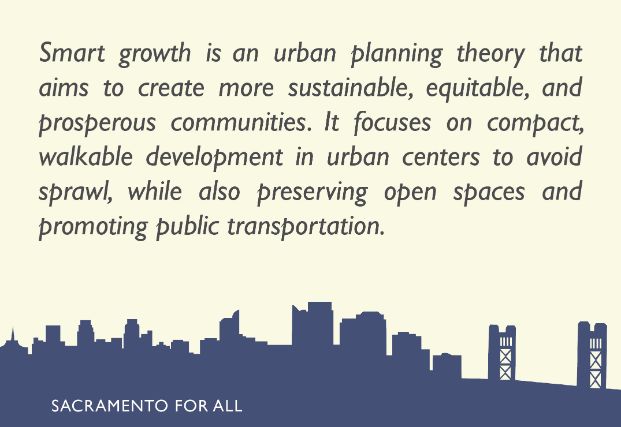
As a largely built out city, new residential development in Sacramento must be accommodated primarily through infill development on vacant and underutilized properties. The City’s planning efforts are guided by “smart growth” principles that aim to promote a compact development footprint, helping to minimize urban sprawl and pollution while supporting the efficient delivery of public service
Additional resources
Please see below for additional resources:
- Smart Growth America
- 2040 General Plan Land Use and Placemaking Element | City of Sacramento
- Infill Development | Governor’s Office of Planning and Research