
Automated Red Light Camera Enforcement Program
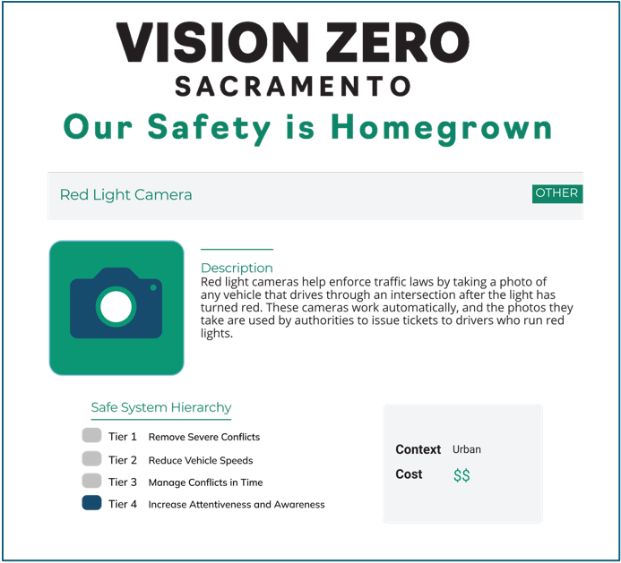
Vision Zero Program — SB 720
The City of Sacramento is moving forward with implementing an Automated Red Light Camera Enforcement Program, with the goal to make our streets safer for everyone— people walking, bicycling and driving. Authorized under Senate Bill 720 (The Safer Streets Act), in January 2026, the Safer Streets Act allowed a new way for local governments to use automated red light traffic enforcement systems. The goal is to prevent collisions. Data shows that red light camera enforcement reduces collisions. Research by the Insurance Institute for Highway Safety (IIHS) found that red light camera programs reduced fatal red-light running crash rates by more than 20% in large cities.
Red light cameras support the City’s Vision Zero commitment to eliminate traffic deaths and serious injuries and are included as a safety tool in the forthcoming update to the City’s Vision Zero Action Plan. As required by State law, the program is administered by the Department of Public Works, not the Police Department
Join us for the upcoming workshop!
Join the City of Sacramento to learn about the Automated Red Light Camera Enforcement Program and share your input. The City of Sacramento invites you to attend a community workshop to learn more and provide input on the proposed Safer Streets Program Automated Red-Light Enforcement Program.
Workshop Details
- Date: Wednesday, October 7, 2026; Time: 6:00 PM – 8:00 PM
- Location: Washington Elementary School, 520 18th St, Sacramento, CA 95811
- What to Expect: Attendees will have an opportunity to: Learn about the proposed Automated Red-Light Enforcement Program, review proposed camera locations and intersection safety information; learn how the program would work, including privacy protections and the civil citation process; meet the project team and ask questions; and share feedback on red-light running and safety concerns in Sacramento
All members of the public are welcome to attend the workshop. Attendees are encouraged to share their perspectives. To RSVP, visit bit.ly/SacramentoRedLightSafety
Program Timeline
Step 1 — Now: Safety Analysis and Community Engagement
Analyzing collision data. Holding public workshops and pop-up events. Gathering community input.
Step 2 — Fall 2026: Vendor Selection and Impact Report Adoption
Equipment vendor selection. Finalizing program guidelines.
City Council Adoption — Winter 2026/27: Program Adoption
City Council reviews and formally adopts the program.
Step 3 — Spring 2027: Program Launch
Cameras installed at selected intersections. Public notified at each location. Program goes live.
How it Will Work
- Camera detects a red-light violation. Cameras photograph only the rear license plate — not the driver’s face. No facial recognition is used.
- Notice mailed to the registered vehicle owner. This is a civil infraction, similar to a parking ticket — not a moving violation. No points are added to your driving record and your auto insurance rates are not affected.
- Fine: $100 for first violation (up to $500 for repeat violations). The maximum is $100, for the first violation. Repeated violations will result in escalating fines up to $500. Income-based reductions available: 80% off for eligible low-income residents; 50% off for those up to 250% above the federal poverty level. Payment plans at $25/month.
- Contest your citation — no court required. You can request an administrative review through the City. Appeal details will be published when the program launches.
Equity & Camera Placement
Camera locations are selected based on collision data and transportation safety — not revenue. State law requires that placements be geographically distributed across the entire city and evaluated for equity impacts. No community will bear a disproportionate burden without documented justification. Site selection is guided by the following criteria:
- Based on ten years of collision history and red-light running data
- Geographically distributed across all Sacramento neighborhoods
- Assessed against socioeconomic equity indicators
- Community input on proposed locations will be gathered before any final decisions
Your Privacy
The Red Light Camera program collects only what is needed to document a violation: a license plate image, the date and time, and a short video clip. No facial images are collected. No continuous recording takes place. Data is retained only as long as needed to process the citation and is deleted upon resolution, consistent with City and State records retention requirements. Program records are confidential under California law and cannot be shared with other local, state or federal law enforcement agencies without a valid court order or subpoena.
Get Involved
We want to hear from you. Community workshops and pop-up events will be held at locations across the city. Dates and locations will be posted here as confirmed. Materials will be available in English, Spanish, and additional languages. Interpretation services will be provided at all workshops.
Upcoming Workshops
City staff will be attending multiple events and neighborhood meetings across the City to discuss this new program. The section will be updated as the events and meetings are scheduled.
- Active Transportation Commission: August 20, 2026 5:30 pm at City Hall. Meeting link and agenda will be available
Stay Informed
Sign up here to subscribe for email updates on the program.
Frequently Asked Questions
How is this different from surveillance cameras?
Surveillance camera systems are designed for continuous monitoring and ongoing vehicle or person tracking across multiple locations. This program is different: cameras activate only at the moment of a specific red-light violation and capture only a rear license plate image. No continuous recording takes place. The program is administered by Public Works, not the Police Department, and does not connect to any law enforcement database.
Where does revenue from fines go?
Any revenue collected goes directly into street safety improvements — it does not go to the City’s general fund. State law requires that funds be used for traffic-calming infrastructure that benefits pedestrians, cyclists, and drivers, such as bicycle lanes, raised crosswalks, speed tables, and curb extensions. Revenue generated will support the Vision Zero program, creating a direct feedback loop: fines fund the safety improvements that help prevent future collisions.
Does this add points to my license?
No. This is a civil infraction, not a moving violation. There are no points and no insurance impact.
Will cameras photograph my face?
No. Only the rear license plate is captured. No facial recognition is used.
How much is the fine?
The maximum is $100, for the first violation. Repeated violations will result in escalating fines up to $500. Reductions are available for low-income residents.
How long is my data kept?
Only until the citation is resolved. Records are deleted after that point.
Can program data be shared with other local, state, or federal law enforcement agencies?
No. Data cannot be shared with state or federal law enforcement agencies without a valid court order or subpoena.
How do I contest a citation?
You can request an administrative review through the City. Appeal details will be published when the program launches.
How do I get involved?
Attend a community workshop or pop-up event or submit written comments online. See the Get Involved section above.
Contact
Chris Dougherty (He/Him)
Mobility and Sustainability Division
City of Sacramento | Department of Public Works