
Street Design Standards Amendment
The City will be updating its Street Design Standards. Sign up to receive Transportation email updates.
What are the Street Design Standards?
The Street Design Standards are a portion of the City’s Design and Procedures Manual – Section 15: Street Design Standards. The City of Sacramento’s existing Street Design Standards are the basis for design decisions regarding city streets such as travel lane widths, bikeway types and widths, sidewalk widths and more. The Street Design Standards influence development, the built environment, and mobility for decades in the future.
What is the Street Design Standards Amendment and why is this effort important?
The objective of this effort is to lay the foundation for improving transportation safety, meeting the City’s climate goals, and expanding our urban canopy.
Safety
The Street Design Standards Amendment aligns with the City’s goals on safety, climate, and mobility. Sacramento has the highest traffic fatalities per population compared to other peer cities in California, with 9.66 traffic fatalities per 100,000 residents:
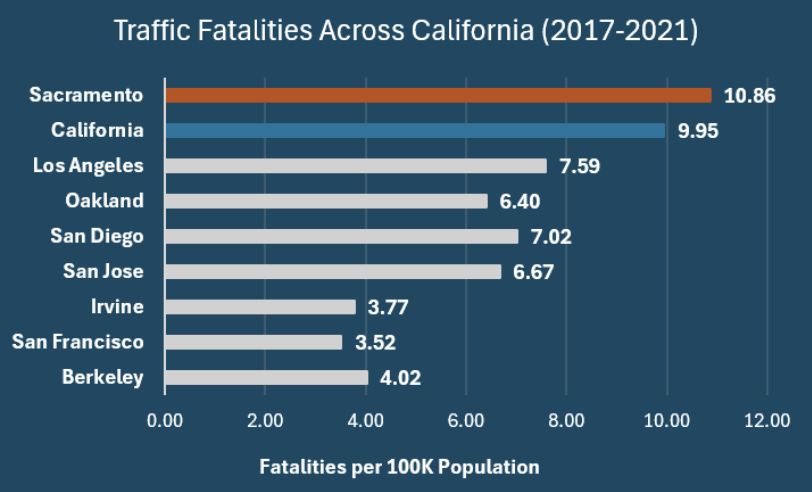
This effort is identified in the City of Sacramento’s Vision Zero Action Plan Action 2.1: Update City street design standards to reflect complete streets and designs reflective of crash reduction factors.
Climate
The Street Design Standards Amendment also aligns with the City’s goals on climate action and sustainability. According to the City of Sacramento’s draft Climate Action and Adaptation Plan (CAAP), 57% of Sacramento’s greenhouse gases are from transportation, exceeding that of the state (40%) and the nation (29%). The CAAP includes goals to improve active transportation infrastructure to achieve 6% active transportation mode share by 2030 and 12% by 2045, and support public transit improvements to achieve 11% public transit mode share by 2030 and maintain through 2045.
As climate change advances, the City of Sacramento seeks to encourage more trips by walking, scooting, bicycling, and transit. To achieve this goal, the City of Sacramento will develop street design standards that center our goals and our priority modes of travel, active transportation and transit.
Urban Canopy
Sacramento is known as the “City of Trees.” Street trees play an integral role in shading sidewalks, outdoor dining, and bikeways supporting active transportation, sense of place and reducing heat island impacts. This effort will consider street tree placement, spacing, and type, as well as projected tree canopy coverage for proposed street sections.
What can you expect from this effort?
The project objectives are to identify:
- Designs to reduce driver speeds
- Designs to improve safety for those walking and bicycling
- Designs to provide low stress bikeways to and through intersections
- Designs to ensure turning drivers see those walking and bicycling
- Designs to accommodate sidewalk widths that align with the City’s goals for walking Designs to support efficient transit operations
- Designs to expand urban tree canopy
This effort will not review signal timing operations or drainage but will review:
- Access control and diversion
- Bikeway types (separated bikeways a street level; separated bikeways at sidewalk level, buffered bike lanes)
- Bikeways at bus stops
- Bikeways at intersections
- Corner islands and turn wedges
- Corners and curb radii
- Crosswalk design (crosswalk type as well as raised crosswalks)
- Curb extension design (avoid impacts to bikeways)
- Design Vehicles (Truck turn design)
- Driveway crossings for bikeways and walkways
- Hardened centerlines
- Intersection sight lines and visibility
- Median refuge islands
- Roundabouts/traffic circles
- Shared-use paths
- Sidewalk and landscape strip widths
- Landscaping and tree selection and spacing standards
- Street cross-section standards that include widths for general purpose travel lanes, bikeways, parking, landscaping, and sidewalks
- Traffic calming (speed lumps, chicanes, raised intersections, traffic circles and similar) Transit stop design
- Travel lane widths, with considerations for 10ft travel lanes and appropriateness in different environments
- Standards for retrofitting older streets with outdated standards
- Design vehicle guidance and best practices for street design with consideration for truck movements on and off approved truck routes; the City’s Vision Zero and Climate goals; and active transportation design features
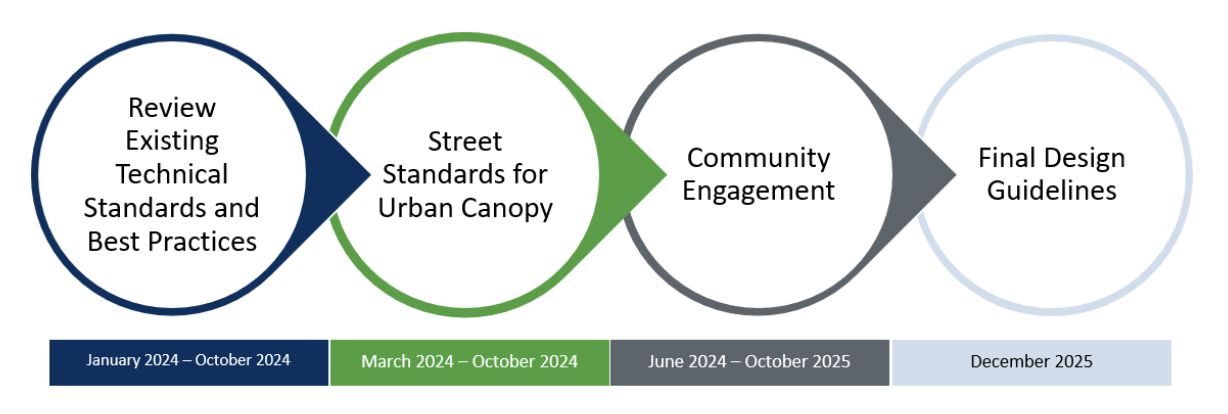
Project Schedule:
Stay in touch with our project team
Subscribe to our mailing list to receive project updates and engagement opportunities.
Project Documents
Project staff will update this site regularly with materials as they become available. This section may include recordings of virtual meetings, presentations, reports, and other items.
Community Roundtable presentation on June 14, 2024
Community Roundtable summary on June 14, 2024
Questions or Comments?
Please submit the following form to provide comments or questions for the Street Design Standards Amendment
Street Design Standards Amendment Comment Box